Tuesday, February 05, 2008

What Milton Friedman really said about immigration.

There has been a lot of purposeful distortion, and some confusion, over what Milton Friedman said about immigration. He is often quoted by the xenophobic activists as saying that you can’t have open immigration and a welfare state. What they don’t do is quote him in his entirety. They always stop before he clarifies what he means and that is why I think they are dishonest.

I have heard Dr. Friedman on several occasions and I’ve heard him address the immigration issue. I clearly remembered his clarification during a speech I heard him give at Stanford University. But, all I could do was broadly state his comments without giving a precise quote.

Now, thanks to the DVDs that Fr33minds is offering, I have Friedman on video stating precisely what he believes about immigration. And, instead of giving you half quotes, like the anti-immigration crowd does, I want to give you his precise words. What follows are direct quotes from Friedman in his lecture, What is America.

Friedman referred to the millions of immigrants and how most came “with empty hands.” He noted that some immigrants in the audience were more recent and said: “You are the modern wave that we ought to be welcoming as immigrants. In the same tradition, as the tradition, which enabled the rest of us to get here.”

You had a flood of immigrants, millions of them, coming to this country. What brought them here? It was the hope for a better life for them and their children. And, in the main, they succeeded. It is hard to find any century in history, in which so large a number of people experience so great an improvement in the conditions of their life, in the opportunities open to them, as in the period of the 19th and early 20th century.

Friedman then goes on to discuss the institutions that are necessary to allow people to become prosperous before ultimately returning to immigration.

He mentions how regulations strangle the ability of people to do good things. And he said he’d like to take, as one example, the issue of free immigration. “I’ve always been amused by a kind of a paradox. Suppose you go around and ask people: ‘The United States before 1914, as you know, had completely free immigration. Anybody could get in a boat and come to these shores and if landed at Ellis Island he was an immigrant. Was that a good thing or a bad thing?'”

You will find that hardly a soul who will say that it was a bad thing. Almost everybody will say it was a good thing. ‘But what about today? Do you think we should have free immigration?’ ‘Oh, no,’ they’ll say, ‘We couldn’t possibly have free immigration today. Why, that would flood us with immigrants from India, and God knows where. We’d be driven down to a bare subsistence level.’

What’s the difference? How can people be so inconsistent? Why is it that free immigration was a good thing before 1914 and free immigration is a bad thing today? Well, there is a sense in which that answer is right. There’s a sense in which free immigration, in the same sense as we had it before 1914 is not possible today. Why not?

Because it is one thing to have free immigration to jobs. It is another thing to have free immigration to welfare. And you cannot have both. If you have a welfare state, if you have a state in which every resident is promises a certain minimal level of income, or a minimum level of subsistence, regardless of whether he works or not, produces it or not. Then it really is an impossible thing.

Up to this point it sounds as if the xenophobes are quoting Friedman accurately. Of course they left out that bit at the beginning where Friedman said to the immigrants in the audience that they are a new wave of immigrants who “we ought to be welcoming.” But Friedman isn’t finished with his comments. And when I heard him at Stanford he said pretty much the same thing as he’s saying here. He clarifies himself in way that the xenophobes never quote!
If you have free immigration, in the way we had it before 1914, everybody benefited. The people who were here benefited. The people who came benefited. Because nobody would come unless he, or his family, thought he would do better here than he would elsewhere. And, the new immigrants provided additional resources, provided additional possibilities for the people already here. So everybody can mutually benefit.

But on the other hand, if you come under circumstances where each person is entitled to a pro-rata share of the pot, to take an extreme example, or even to a low level of the pie, than the effect of that situation is that free immigration, would mean a reduction of everybody to the same, uniform level. Of course, I’m exaggerating, it wouldn’t go quite that far, but it would go in that direction. And it is that perception, that leads people to adopt what at first seems like inconsistent values.
Now Friedman goes even further with his clarification. And pay special attention to what he says here.
Look, for example, at the obvious, immediate, practical example of illegal Mexican immigration. Now, that Mexican immigration, over the border, is a good thing. It’s a good thing for the illegal immigrants. It’s a good thing for the United States. It’s a good thing for the citizens of the country. But, it’s only good so long as its illegal.
There is no question that Milton Friedman said that in the welfare society “illegal immigration” is precisely the kind of the immigration that the country needs. The xenophobes have turned his views inside-out. They will pay lip-service to legal immigration and damn illegal immigration. The fake libertarians, social conservatives, and racists try to make it sound as if Friedman was against illegal Mexican migrants. In reality he said that such immigration is “a good thing” for everybody concerned. And his reasoning is that this is the closest thing to pre-1914 immigration possible in today’s welfare state. Friedman says this is the paradox of government intervention that turns an illegal act into a beneficial one, while legal immigration is a potential problem. Notice that the groups that quote Friedman never quote his saying that illegal Mexican immigration is good.
That’s an interesting paradox to think about. Make it legal and it’s no good. Why? Because as long as it’s illegal the people who come in do not qualify for welfare, they don’t qualify for social security, they don’t qualify for the other myriad of benefits that we pour out from our left pocket to our right pocket. So long as they don’t qualify they migrate to jobs. They take jobs that most residents of this country are unwilling to take. They provide employers with the kind of workers that they cannot get. They’re hard workers, they’re good workers, and they are clearly better off.
Friedman’s position is exactly the one I remembered from his Stanford lecture and precisely the one I’ve taken on this blog. And I have long credited Friedman as the source of my view.

The opponents of immigration, who attempt to use Friedman to bolster their case, are dishonest in the way they do it. They distort his view, and cherry-pick comments that sound good to their case, while ignoring the actual clarification of his views that Friedman makes a special effort to express. In addition, they don’t ever propose Friedman’s solution. They merely say that the only possible choice is to stop immigration to the United States.

There are three options that we can take which are consistent with Friedman’s view, and the xenophobes reject all three of them. First, we could abolish the welfare state entirely. They assume this won’t happen anytime soon, so acknowledging this position is a safe one for the racist, since it is unlikely it will mean immigration by “those people” any time soon.

The second option is actually quite easy to implement. That is to selectively abolish welfare benefits denying them to any immigrant. This denial could be for their lifetime or require them to be gainfully employed for X number of years before they qualify. This solution, which is feasible now, is not one suggested by the “libertarian” anti-immigrant crowd. It is not suggested precisely because it is possible now, and might actually lead to immigration. What these people oppose is not the welfare, as much as immigrants.

The third option is one that the xenophobes have actively campaigned against—and that is the illegal immigration of migrants across the Mexican border. This is the one that Friedman specifically said was “good” for the country, the American people and the immigrants themselves.

Now you know what Milton Friedman actually said.

All quotes are verbatim transcripts from comments made by Milton Friedman in the 15 lecture series being sold by Fr33minds.

Editing Note: Since the piece was published Laissez Faire Books changed hands and we can not in good conscience endorse that business anymore. For an explanation of why read this. The people responsible for turning Laissez Faire over to bigots should be ashamed of themselves. As a result we have instead pointed to a new source for libertarian books that is everything that LFB used to be, but is no longer. Mary Ruwart destroyed Laissez Faire.

Labels: ,

Tuesday, May 22, 2007

Milton Friedman's rises from grave spreads death and disaster in wake.

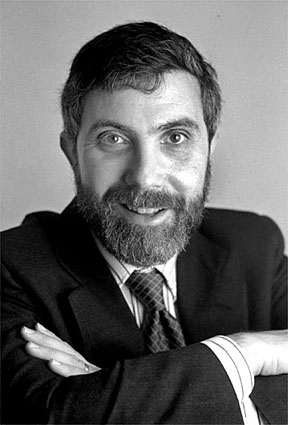
I have long thought that one of the worst writers around is Paul Krugman. He is just a very nasty man with issues. His hatred overflows his columns regularly.

One of his more absurd opinion pieces was recently published in the New York Times. At least with opinion pieces he doesn’t need facts or evidence. He just needs an opinion, his hate and a cup full of irrationality to boot. Economist Russell Roberts has brought to my attention that Krugman is now claiming the Milton Friedman is responisble for people dying.

Yes, the much honored but deceased economist is supposedly responsible for people dying at this very time. And he uses food scares to prove his point. Terror is an effect weapon and Krugman doesn’t mind using it. I don’t mean terrorism just the stirring up of terror, the fear-mongering that Statists like Krugman (and I should add his counterparts on the Right) use with amazing regularity.

Who’s responsible for the new fear of eating? Some blame globalization; some blame food-producing corporations; some blame the Bush administration. But I blame Milton Friedman.

He mentions the various cases of E. coli where people get sick from the food we eat. So was Uncle Miltie running around the fields before his death lacing the fields with poison to knock off people long after he’s gone. It concerns me. I had dinner with the man. I sat next to him at the table. I even left my food unattended at a couple of points during the meal. Perhaps I should rush off to the clinic for an exam. No doubt the moment I mention Milton Friedman I’ll be rushed into intensive care. But then that was some years ago but maybe it’s just slow acting! I do fear a bit warm. (Which couldn’t be anything to do with hot summer weather we are having here.)

How does Krugman prove his point. First, he mentions that Friedman was a critic of government consumer protection. Friedman argued it didn’t work well. He argued it didn’t really make consumers safer and it had unintended consequences that often made them worse off and it cost a lot of money in the meantime.

Krugman’s view is the opposite. If there is a state control that someone proposes Krugman gets orgasmic over it. He has wet dreams over socialism just call it something else.. He thinks a book of photos of Stalin, Marx, Mao, Castro and such is just raw erotica.

According to Krugman the laughable Bush administration is not pushing through new strong controls (see I told you he gets aroused at the very thought of economic bondage) because they are in the grips of a free market ideology. Okay, so it is laughable. The reality is that none of Friedman’s suggestions on this matter were tried. What is in place is the system that Krugman and his allies advocated.

Some would say that the food problems still arise with regulations show that the regulatory system itself doesn’t work. Krugman’s view is relatively consistent. He always says the controls were stringent enough, big enough, broad enough. He always advocates more state power. No one he hates Milton Friedman.

Now is it Bush? That is a different question and one that can’t be so easily dismissed. Bush is supremely inept when it comes to the occupants of the oval office. His handling of Katrina was a clear indication of that. Ditto for the war, the budget, constitutional liberties, ad nauseum. But beyond lip service paid by Bush to woe his own Republican base there hasn’t been an administration so NOT influenced by Friedman. It takes a certain kind of insanity to accuse Bush of believing in too much freedom.

But are E.coli outbreaks really that unprecedented that Krugman thinks he can use them to slander a dead man? Actually not but then facts are not on speaking terms with Krugman. Let’s look at past recent E.coli outbreaks.

During Bush, who I also loathe as anyone reading this blog knows, we had an E.coli outbreak where 70 people got sick from some infected meat. And then there was the fresh spinach outbreak of last year were 200 got ill and three died. Still pretty awful stuff but hardly earth shattering.

So how about under Mr. Clinton? In 1999 there was an E.coli outbreak in New York state that sickened 781 people. That’s way more than under Bush though Bush did have three fatalities. But that isn’t the end of the outbreaks under Clinton. In 1997 there was another outbreak with 108 becoming sick and three having kidney failure. Still no deaths. In 1996 there were 70 cases of E.coli infections and one died. In 1994 another 23 were infected and in 1993 over 700 people were infected and four of them died.

It is rather gruesome but we do need to do a body count here. Bush: 270 sick, 3 deaths. Clinton: About 1,700 sick and 5 deaths. Was Milton Fridman sneaking into the White House at night and whispering in Bill Clinton’s ear?

Before becoming an journalistic hit-man Krugman was also a paid adviser to the Enron company. Not exactly prime credentials in my books. Even the omsbudsman for the New York Times had to say that “Krugman has the disturbing habit of shaping, slicing and selectively citing numbers in a fashion that pleases his acolytes but leaves him open to substantive assaults.”

Labels: ,

Monday, April 02, 2007

Media bias and the intellectual gate keepers.

I know that conservatives and some libertarians are obsessed with bias at the New York Times. The problem is that they are wrong and right at the same time. There is bias at the Times -- atrocious bias at times. But not in the ways that they think.

I have seen individuals point to bias by pointing to editorials. Except an editorial is an expression of opinion. It is not a news article at all. They conclude that because an editorial is expressing an opinion that news stories can’t be trusted. Newspaper stories do endeavor to be accurate but there is reason to be skeptical.

But the skepticism is not due to bias on the part of the journalists (though that can happen and good newspaper try to weed out those writers). The reason to be skeptical is merely the time frame which newspapers work with. Initial reports of any news events are the most unreliable. The more immediate the report the more likely that inadvertent falsehoods get inserted. Truth takes time and news is often time adverse. When the planes hit on 9/11 people wanted to know instantly what was going on.

The net result of immediate news is a fueling of conspiracist craziness. The conspiracist leaps upon any inconsistency as proof that someone is trying to hide something or intentionally distort the facts. Rumors that get reported in the early reports take precedence over information that was verified over time provided the initial reports back up the theory in question.

Rarely is it the news stories that exhibit the most bias. Bias there exists but is more subtle. There the bias is more likely to be exhibited by who gets quoted. The typical journalist, and having majored in this field in university I can verify it, is left of center. So they often assume that any “expert” saying something they agree with is clearly clued up on the topic and anyone disagreeing is obviously fringe. And that assumption gets through in many stories.

The facts mentioned are usually correct, though there have been notorious counter-examples, as we shall see. What the facts mean is where they almost always go wrong.

Where the real bias comes in is through their editorials and various “opinion” pieces. Again the people the journos find “respectable” are the people who get to write. And “respectable” means that the author agrees with the journos. Typically that means the editorial writers of the paper are pretty much left of center. To balance things out they periodically will take guest opinion pieces from other writers who don’t share their biases. Rarely, however do they get a fair shake. Some papers are extraordinarily fair in such matters and others notoriously unfair.

The worst section is the arts section and it is here that books are reviewed. Often books that disagree with the left bias (it isn’t a liberal bias) are simply ignored. Numerous, scholarly books that showed the greater complexities of the origins of World War II, for instance, were notoriously ignored by the major media. Historian Harry Elmer Barnes referred to that as the “blackout”. To a large degree that blackout lasted from 1940 until A.J.P. Taylor’s more popular treatise, The Origins of the Second World War was published in 1960.

When they do stoop to cover a book outside the “mainstream” they almost invariably give the review of the book to someone who is extremely biased against the book and spends the bulk of the review trashing it. For instance I have a clipping in my files of a review (which I think was in the New York Times) of Human Action by Ludwig von Mises. It was turned over to a sneering and snide John Kenneth Galbraith for comments. Of course no scholar of the stature of Mises, Hayek or Friedman was asked to review the latest Left-wing treatise on economics.

This process, whether intended or not, serves to create intellectual gatekeepers who prevent or hinder ideas contrary to their own from seeping into the market of ideas. Book buyers for book outlets often take their cues from such reviews. So do academics, libraries and others. To be ignored by the major papers, or smothered by derision, is one way that the Left prevents ideas contrary to their own from seeping out. (I should note that this is preferable to that of the Right which has a tendency to call for banning anything they don’t like. And I should note that with new technologies the ability to control the gates is diminishing.)

What brought all this to mind was a review that the New York Times ran of the new book Radicals for Capitalism. I read the review at the time and thought it relatively poor and clearly written by someone uniformed about the facts. I didn’t blog about it at the time because I’ve yet to read the book. But I was troubled by the review. Troubled because it seemed inaccurate to me but without reading the book in question I wasn’t going to try to pick about the review. Thankfully David Boaz at Cato has read the book and the review and he has shown how bad the review actually is. In actuality I suspect he might be too kind.

The reviewer said: “Libertarianism has its roots in the writings of a pair of major 20th-century Austrian economists, Ludwig von Mises and F.A. Hayek.” Well, that is simply wrong. Libertarianism predates Mises and Hayek. Sure they were major influences on the libertarian movement of the last century but there were influential libertarians who were writing long before Mises or Hayek made a name for themselves in the US: Mencken, Nock and Spooner are three examples. I can’t believe that the book, written by Brian Doherty, at Reason, had made this mistake. I suspect he hasn’t.

And I also suspect the reviewer, David Leonhardt, only read bits and pieces of the book as interested him and this distorted his review. He certainly complained about the length of the book in a couple of snide remarks he made.

And he catalogues, from the book, “the movement’s failings”. Now I don’t know the context of the book but I do know the context of the failings that Leonhardt mentioned and he has distorted them grossly. He sneeringly refers to “people who claim to love freedom” but “have so often had a soft spot for those who would deny it to others”. But the cases Leonhardt catalogues are, for the most part, false.

He mentions Rand’s testimony before the House UnAmerican Activities Committee. Of course he doesn’t say what it was she talked about. Rand never went to HUAC to talk about individuals and whether they were communists. She was not there naming names. Her comments never came close to that. She wanted to talk about ideas and tried to but the HUAC members wanted to concentrate on what life was like in Russian—which she experienced first hand—versus how it was depicted in a second rate film Song of Russia. How that is having a “soft spot” for those who would deny freedom is never explained by Leonhardt. In fact Rand wrote an essay which dealt quite clearly with her views on the matter and she said the only proper way to fight bad ideas is which good ideas not with censorship and state interference. Leonhardt distorts the history of Milton Friedman claiming he “advised” Pinochet. Friedman met Pinochet once and told him the same things he told the leaders of Communist China or the President of the United States. But the Left loves to concoct a Friedman connection to Pinochet that really doesn’t exist.

The one that I found bizarre when I read it was that “Merwin Hart ‘infected his free market thought with anti-Semitism.” This site is vehemently opposed to anti-Semitism and bigotry of a similar kind. But my first thought was that I never understood Hart to be a libertarian. And I couldn’t figure out why Leonhardt was using this as an example. But I didn’t have time to go into the matter so I didn’t write on it. I had heard of Hart and knew he was an anti-Semite I just didn’t remember anyone saying he was a libertarian before. David Boaz wrote about it:

Despite 30 years in the libertarian movement, and despite having read this book, I had never heard of Merwin Hart. But I found him in the index (not always an easy thing; the best criticism of this book, which Leonhardt missed, is that the index is seriously inadequate; the Rand paragraphs on HUAC, for instance, are on page 188, not 150 as the index indicates). Turns out he ran something called the National Economic Council in the 1950s. And why is he in this book? Because he’s a major libertarian figure? Because he’s a minor libertarian figure? No. He gets one line in this book because movement founding father Leonard Read told people to stay away from Hart because, yes, he “infected his free-market thought with anti-Semitism” — in other words, he wasn’t one of us.

Of course any movement has its fringes but do you judge the movement by the fringes or by the mainstream thought within it? Libertarians have fringes that worry me greatly, individuals who are far too comfortable with racism, anti-Semitism, white supremacy and such. Most libertarians aren’t like that. If anything libertarians are too tolerant—that is how such bigots get in to movements in the first place.

But if you look at the major institutions of libertarianism like Cato, FEE, Reason, Heartland, the Institute for Economic Affairs, the Adam Smith Institute and so forth, you don’t find them cavorting with bigots.

What Leonhardt did is typical of how the gatekeepers work. He distorts the history that the book is talking about. In the process he ridicules libertarian ideas and he gives people a false impression about the nature of libertarians. He implies the book is too long while complaining about what was left out at the same time. The review would discourage libraries from ordering it, bookstores from buying it, readers from purchasing it, and sends the message to the intellectuals that the libertarian message is itself vastly deficient.

I have no doubt there are deficiencies in libertarianism. Just as there are in conservatism, socialism and every other human ideology. That is the problem of not being omniscient, there are flaws. But when stacked up against the other ideologies it actually does quite well for itself. And even if a few authoritarian types smuggled themselves into the movement it isn’t as if libertarians need to apologize half as much as the political Left has to for the tyrannies of Pol Pot, Mao, Castro, Stalin, Mugabe, et al. Nor do libertarians need to apologize to the world the way conservatives do over the coronation of King George.

Sure Rand had her personality quirks and could be a real bitch sometimes. Rothbard did do some strange and odd things but justifying genocide wasn’t one of them—something the Left did repeatedly. And as Boaz points out the New York Times doesn’t have a spotless record on that count. As he notes the notorious Times writer Walter Duranty used the paper to falsify, knowingly, the tyranny in Stalinist Russia. Compared to that the worst temper tantrum of Ayn Rand is nothing.

Murray Rothbard might have voted for Strom Thurmond when he was 22. (He did far odder things than that throughout his life.) But how does that compare to a reporter from the New York Times, Herbert Matthews, who wrote stunningly pro-Castro diatribes for the paper, distorting the facts and helping to create a dictatorship? Matthews bragged: “Many people thought that Fidel would listen to me, and only to me.” Friedman merely told Pinochet the same thing he told anyone who would listen. Matthews was friends and and an adviser to Castro. Friedman met Pinochet once for less than an hour. Friedman never wrote anything extolling the virtues of Pinochet but Matthews did write a book praising Castro even after his authoritarianism was no longer closeted.

Labels: , , , , ,

Thursday, March 23, 2006

New Friedman documentary to show.

A new documentary on the life and influence of the great Milton Friedman has been completed and is scheduled to be shown on PBS later in the year. The documentary, entitled, The Power of Choice, is by the same producer who worked with Friedman on the Free to Choose series.

Dr. Friedman is one of the best communicators of the principles of classical liberalism, he is truly a gentleman and a scholar.

Labels: