Friday, November 26, 2010

Some Thanksgiving humor.


This captures the reality of the Pilgrims quite nicely. At no point did they come seeking religious freedom, at least not for anyone but themselves. As written here not long ago:

Consider the Pilgrims as an example. Most people heard the story that the Pilgrims came to America to enjoy religious freedom. That most certainly is not the case, not if you mean freedom for everyone. Their desire was freedom for themselves and tyrannical control over others. Puritan divine Richard Mather said the Pilgrims came to the colonies in order “to censure those who ought to be censured.” Steven Waldman, in Founding Faith, says that “it might be more precise to say most [Pilgrims] were avoiding the harassment of a government that wanted the Puritans to be more liberal". He mentions how the Puritans had banned games and amusement in areas under their control in England. Certainly when they had control of England, under Cromwell, they went so far as make Christmas illegal. Yes, the first real war on Christmas was conducted by fundamentalist Calvinists against all other Christians.
They were most unhappy, later, when King James overturned their bans and granted more liberty to the people. The liberty the Puritans sought was to be able to wield the whip in God’s name, and wield it they did. Quite literally.

This yearning for authoritarianism even inspired some Puritans to rebel against the King when the Revolution came along. Rev. James Mayhew, of Boston, said that rebellion against the King is justified when the King commits crimes against God. Since the King had allowed sports on Sunday and “encouraged papists and popishly effect clergymen,” he was against God and thus oppressing the people. For the Puritan, one reason to overthrow the throne, and seek independence from England, was in order to erect a repressive moral regime far stricter than what the lax monarch had allowed
Read the whole thing here:

Labels: ,

Wednesday, March 18, 2009

Arkansas votes to ban first communion.

The Calvinist influence in America screwed up the country. Calvinists screw up most countries when they dominate and the Puritans dominated for far too long in America. One area where their moralistic authoritarianism got out of control was the issue of the consumption of alcohol. That silliness reached its height when Prohibition was passed. But don’t assume that puritanical prohibitionism is dead, not by any means. Any authoritarian piece of legislation can be passed in modern America if you just invoke “the children.”

That is what happened in that social backwater known as Arkansas. Dan Greenberg, a member of the legislature reports on a new anti-drinking law.
Here’s how the bill works: if you have control over private property, and you allow anyone under 21 who isn’t your relative to drink alcohol, or just to stay on the property after they drink alcohol, you’ve committed a class A misdemeanor. However, if you’re not on the property, you are free from criminal liability, as long as you’re not “present and in control of the private property at the time the consumption occurs.”
Let’s examine how this works in a bit more detail:
If the person who controls the property — call her “Mom” — sticks around while underage drinking occurs, she’s committed a misdemeanor.
Suppose, on the other hand, Mom hears a knock at the door and sees her daughter welcome her best (underage) friends Jane and Mary in; if Mom announces that she’s going across town to catch the 7:15 showing of “Bride Wars” and drives off, she’s free from criminal liability if underage drinking occurs.
Greenberg, who clearly thought about the issue, noticed a lot of problems. First, under this legislation first communion in many churches would now be a criminal offense. Of course that won’t hold true if the priest is giving the wine to his own child but that situation would raise eyebrows amongst the congregation.

Also note that the law basically requires that teens, who are drinking, do so without any adult supervision. This is what I find stupid. Dr. Robert Epstein, in his book The Case Against Adolescents, makes a strong case for ending the modern practice of treating teens like children. He argues that the results of such policies are counter-productive. One problem is that our modern culture compartmentalizes teens into one category. We actively separate them from the adult world. They learn their socializing skills, not from adults, but from other teens who are as unfamiliar with the adult world as themselves.

In American drinking is seen as an “adult” activity. Yet no teen, growing into adulthood, can learn to drink socially from his parents. Teens will drink, law or no law. And they can learn how to drink from other teens or from adults. But the politicians find it wiser to force teens to learn how to drink from inexperienced teens who know no more than they do.

That is what happens in states where adults can be prosecuted if teens drink on their property while they are there. As Mr. Greenberg notes, the law gives an incentive for parents to avoid being around when teens drink. Even more stupidly the law requires the adult to evict any teenager who has been drinking on their property. So if two parents arrive home late at night, and find their teens had some friends over who were drinking, they are now obligated to tell these teens, inebriated or not, that they must vacate the premises. To require them to stay where they are until they sober up would put the parents at legal risk. Some of those teens will drive with that alcohol in their system. Maybe they will walk home. Sure, I can see the benefits of sending drunken teenage girls out into the streets in the dark of the night to avoid legal prosecution.

One of the things that I had to get used when living in Europe was the different attitude toward alcohol. Many homes routinely serve wine or beer at dinner including to “underage” children. Young teens will walk around with beer in their hands and no one says a word. One event I won’t forget was attending a Beer fest at a German high school, but outside of Germany. It was a German-language school for Germans living in that particular part of the world.

The event was packed out. The school itself had several hundred students attending. And many from the local German community attended. My pleasure was perhaps less than others since I don’t drink beer. But there were more varieties of beer on tap than I knew existed. And anyone, of any age, was free to drink—and they did. I suspect that close to 100% of the high school students at this school were drinking on school grounds with their teachers and parents. And no one was horrified. That is an American reaction.

There is no sudden transition for these kids. They don’t suddenly turn 21 one day and acquire the right to drink. They have been drinking for years already. In Europe something like 90% of individuals in their mid-teens drink and the average age to begin drinking is 12. Yet an EU study on drinking in Europe, while acknowledging that “Europe has the highest levels of consumption in the world” they also note that “European drinking patters are among the least damaging in the world.” (page 96)

This study still recognizes that drinking still creates some levels of harm, so it isn’t pretending that there are no problems associated with alcohol consumption. Yet, if this EU study is correct, while Europeans drink more than Americans, and begin drinking earlier than Americans, their drinking does less damage than does American drinking. Could one reason for this be that European teens are not be “protected” the way American teens are?

Rep. Greenberg says the sponsor of the bill acknowledged that it had problems. That, of course, didn't prevent the moralistic wing of the legislature from passing the bill "for the sake of the children." The bill's sponsor told him they would fix the bill later. Greenber said: "I tend to think that the only way to fix the bill's problems is to run it through a shredder, incinerate the remains and bury what's left in a big hole."

Labels: , ,

Tuesday, July 10, 2007

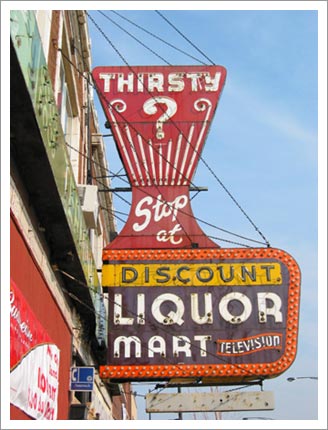
The puzzle of American liquor stores.

Economist Bryan Caplan has been accumulating items that puzzle economists. One that he wonders about regards liquor stores. Here is how he words it:

There's a lot less economic freedom in my state of origin, California, than in my state of residence, Virginia. According to the Pacific Research Institute's rankings, the state of California comes in 49 out of 50th. Virginia comes in 3rd. As far as liquor is concerned, however, it looks like you can flip those rankings. In Virginia, you can buy beer and wine from the grocer, but hard liquor is only available at Virginia Alcoholic Beverage Control stores. (For their sickening propaganda, go here). In California, you can buy hard liquor almost everywhere
If I didn't know anything else about these states, I would predict that California's grocery stores would dominate the liquor market. Why make a special trip to a seedy liquor store when you can buy tequila at CostCo during your weekly shopping?
But this prediction is way off. The blatant fact is that there are seedy liquor stores on virtually every commercial street corner in Los Angeles. People are free to buy their liquor in regular grocery stores, but for reasons I can't grasp, grocery stores only seem to have a modest slice of the market.
Another way to think about this Los Angeles Liquor Puzzle: It seems like the Wal-Mart model should be working, but it's not. The mom-and-pop liquor stores are thriving in the face of big(ger) box competition.

Many smart people took stabs at this puzzle. Typically the argument was one of “specialization”. A liquor store has a wider selection. True, but a video store has a bigger selection than Wal-Mart yet Wal-Mart still have a big video selection.

Others argued that it was more convenient to shop at the liquor store since it was easier to park, easier to shop, not as crowded, etc. Again, that is true. But this is also true about any item in Wal-Mart. The auto store has more convenient parking as does the hardware store but still people will purchase auto supplies or hardware at Wal-Mart.

One person got close to what I think may be the answer. He said people don’t stock on liquor for the same reason married men don’t carry condoms. The stocking up on liquor, which is how people shop in grocery stores, makes one feel like an alcoholic.

I think there is a “shame” factor involved. America was the one “civilized” country to ban alcohol and that was less than a 100 years ago. Much of that was based on the assumption that drinking was sinful. The counter-argument is that many people today no longer see drinking as sinful. True. On the other hand, they do see being a drunk as a problem. Most people look down on one being an alcoholic.

In the grocery store you are likely to run into neighbors, friends, work colleagues, relatives, etc. And if you have a few bottles of liquor lined up next to the veggies some people might wonder. This, I would think, is especially true for hard liquors. When people see a lot of booze they wonder if a person has a drinking problem.

Liquor stores are like porn shops. A consumer walks in knowing that anyone else in the shop is not going to judge him negatively for being there.

And porn is a good comparison. Large bookstores could have adult sections if they wished. But they don’t. One factor is that people who hate porn would boycott them. The same is true with liquor as many fundamentalist types would avoid any store selling demon rum. But the boycott factor would be lower for liquor. But more likely, the porn consumers aren’t willing to purchase there.

They would be most unlikely to take their purchase up to the cashier if there is some chance that other people in line would react negatively to their purchase.

Inside a porn shop or a liquor store everyone is pretty much there for the same reason. And the moralistic view still pervades much of America even if it is replaced by “health concerns” among the more secular.

Other cultures react differently. The grocery stores in Europe have large liquor selections including hard liquor. But then Europeans are allowed to drink on the streets or on the trains. Even teens standing around drinking beer don’t attract any attention. The issue has none of the moralistic aura that it does in the United States.

Even porn is seen differently in Europe. You will find major airports (outside the UK) which have porn shops in them and the same is true for train stations. And I was surprised to see a selection of hard core DVDs for sale inside one of these quicky mart shops attached to a petrol station in the Czech Republic. What was even more surprising was that it was off in the corner away from the cashiers.

Many of the large video stores in Europe carry adult material. I’ve seen hardcore DVDs for sale in Virgin shops in England but did not see them on sale in Virgin shops in the US. A massive six floor electronics/video store opened a few blocks from my flat. They carry adult material which is displayed under a red transparent cover. And that is just stuck in the middle of the shop. Except for the red transparency, which makes them stand out while slightly masking the images, no other effort is made to restrict access.

There must be liquor stores here in Europe. But the truth is that I don’t remember seeing any. There are none in my neighborhood. All the stores carry adequate selections of liquor and the largest department store in Europe is two blocks away. I have wandered past their liquor selection but I don’t drink so I didn’t pay much attention. But I believe it was rather massive. But then this store has a selection of chocolates that are bigger than my normal grocery store.

In the end I think the answer to the puzzle relates to the American concept of sin. And often the theology dies out long before the puritanical nature of the believer does. Even in those parts of the us that have shunned fundamentalist moralism there is still a lively puritanical sentiment.

Labels:

Thursday, March 22, 2007

The triumph of Puritanism.

If you drive through any American city you will find a multiplicity of sects, cults and churches. An American is pretty much free to believe any of them, several of them, or even none of them.

One can be a Mormon of the Salt Lake City variety and, if that doesn’t suit you, there is the Reorganized variety of Mormons out of Missouri and a dozen or so other splinter groups. You can be Episcopalian, Methodist, Baptist, Unitarian, Presbyterian, Pentecostal, Buddhist, Muslim, and so on. You can preach the doctrines of any of these faiths or denounce the doctrines of any or all of them as you wish. It’s called freedom of religion.

That the Jehovah’s Witnesses are allowed to operate does that mean that “society” is sanctioning that particular faith. The government is not saying that being a Jehovah’s Witness is better than being a Baptist or more moral than being an atheist. That's obviously the case! I say obviously because the government can not be sanctioning one church over all others if all the others are just as legal.

Nor is government saying that one must be religious. Atheism is equally protected. There is no stamp of approval put on religion just because it is legal. Nor is there a stamp of approval on irreligion just because it is legal.

This is all pretty obvious when it comes to religion. Freedom of choice is not a social or governmental sanction on the choices that one may make. All that government is doing is staying neutral. It doesn’t attempt to rank these groups in any preferred order. It endorses none of them and disparages none of them.

But a lot of people assume that moral issues, those of a private nature which never infringe the life, liberty or property of others, ought to be a governmental concern. And they will argue that the reason for this is that if government repeals laws against certain kinds of “sins” then government is sanctioning those sins.

If prostitution is made legal they say that means the government is telling people that it’s just fine and dandy to be a prostitute or hire one. The same people don’t want other churches shut down. The Methodist doesn’t argue that allowing Episcopalians to worship means that government is telling people to go out and become Episcopalians.

But apparently if some “moral” issue isn’t legislated the religious, in particular, tend to get all worked up, arguing that legalization is sanction. If drugs were legalized, they say, then government is telling people that there are no problems with using drugs. Much the way if religious is free then government is saying there is no problem with joining a cult.

I have never heard anyone explain why freedom of religion (which remember means the freedom to being irreligious and even anti-religious) doesn’t mean sanction. But, at the same time, freedom in private morality does mean sanction.

All freedom means is that these are private decisions. You are still free to rank activities as highly or lowly as you wish. You are free to condemn or condone. It is not that the state is approving the activity it is simply saying that it is outside the purview of government.

There is great danger in the premise that anything which is legal is sanctioned. There are many things which people do which are not necessarily the best things for them to do. If legality is a moral stamp of approval then the state would have to make much of life illegal. This is precisely what is happening. Left-wing Puritans, who share the Right-wing Puritan's premise that anything legal is sanctioned, are rushing around finding things which are the Leftist equivalent to sin and demanding it be banned. It's a form of Blue Laws all over again.

Nanny statism is basically the extension of the premise of Right-wing religionists to all aspects of human existence. If fatty foods are bad for you then fatty foods must be banned otherwise the state is sanctioning obesity and heart disease. It is the exact same argument used by the Right. Instead of fatty foods insert prostitution, instead of sexist language insert obsene language, instead of smoking insert drug usage. You can do this for issue after issue.

Conservatives aren’t against the Nanny state they invented it. They created the premise that legalization equals sanction and all the Left has done is take that premise and run with it. Of course they have differences of opinion over what ought to be sanctioned hence the culture war. At heart both are Puritans and that is not a compliment. Abandon the premise and the culture war disappears.

Labels: , ,