Wednesday, May 19, 2010

A cracker of a beginning. Stunning actually.

In my report on the UK elections I said that I suspected that the Tories and the Liberal Demcrats would form a coalition government, even though Labour was courting the Lib Dems. That happened. I was cautiously optimistic that the coalition "will form a more liberal [in the classical sense] government than the UK has seen in a very, very long time."

I felt there was a chance this coalition would make each of the two parties in government better than they would be governing alone. I am still optimistic, but more so, especially after the stunning announcements of Deputy Prime Minister Nick Clegg, of the Lib Dems. This is a man I've had my eye on for sometime and previously noted that he has been moving his party in a free market direction, without compromising their social liberalism. The big problem tends to be that parties are quite libertarian sounding when out of power and very statist when in power.

But Nick Clegg made an announcement that is absolutely breath-taking—one I can't remember any politician doing in my lifetime. He called on the public to submit recommendations for what laws need to be abolished. He didn't say reformed, he said abolished, as in axed, in the ashcan, obliterated from the books, ended, cease to exist, gone! This wasn't a pre-election speech but a post-election speech.

He said: "This Government is going to transform our politics so the state has far less control over you, and you have far more control over the state. This Government is going to break up concentrations of power and hand power back to the people, because that is how we build a society that is fair." Has he read my mind, or my blog? While I doubt that is the case, that is entirely the point I make about power, that it destroys fairness and harms the most vulnerable in society. If you have the heart of a modern liberal then you need the policies of a classical liberal to achieve your goals. Freedom helps people! It seems Clegg gets it.

He promised a "fundamental resettlement of the relationship between state and citizen that puts you in charge." Here are a few bits from the speech (if anyone finds a video of it let me know).
As we tear through the statute book, we’ll do something no government ever has: We will ask you which laws you think should go.

Because thousands of criminal offences were created under the previous government. Taking people’s freedom away didn’t make our streets safe.

Obsessive law-making simply makes criminals out of ordinary people.

So, we’ll get rid of the unnecessary laws – and once they’re gone, they won’t come back.
We will introduce a mechanism to block pointless new criminal offences.”
The London Telegraph reports the reforms announced:
...will involve the end of the controversial ID cards scheme, the scrapping of universal DNA databases – in which the records of thousands of innocent people have been stored – and restrictions placed on internet records. The use of CCTV cameras will also be reviewed.

Dubbed the “Great Reform Act”, the measures will close down the ContactPoint children’s database. Set up by Labour last year, it includes detailed information on all 11 million youngsters under 18. In addition, schools will not be able to take a child’s fingerprint without parental permission.

In an attempt to protect freedom of speech, ministers will review libel laws, while limits on peaceful protest will be removed.

The measures to repeal so-called surveillance state laws will be included in next week’s Queen’s Speech. Under the coalition agreement, Mr Clegg and David Cameron said they would end “the storage of internet and email regulations and email records without good reason”. This is likely to mean the end of plans for the Government and the security services to intercept and keep emails and text messages.

The £224 million ContactPoint database can be accessed by 300,000 people working in health, education, social care and youth justice – leading to fears it could be exploited or fall into the wrong hands.
Mr Clegg will add: “It is outrageous that decent, law-abiding people are regularly treated as if they have something to hide. It has to stop. “This will be a government that is proud when British citizens stand up against illegitimate advances of the state. That values debate, that is unafraid of dissent.”
I'm gobsmacked and thrilled. In my heart I'm dancing around the room shouting. The Daily Mail reports that Clegg "pledged the boldest rolling back of the state in modern hisotry. They say that Clegg said: "Incremental change will not do. It is time for a wholesale, big bang approach to political reform." He says: "We will end practices that risk making Britain a place where our children grow up so used to their liberty being infringed that they accept it without question." Wow! Because this is such a stunning announcment I will publishe the entire speech below:

I have spent my whole political life fighting to open up politics. So let me make one thing very clear: this government is going to be unlike any other.

This government is going to transform our politics so the state has far less control over you, and you have far more control over the state.

This government is going to break up concentrations of power and hand power back to people, because that is how we build a society that is fair.

This government is going to persuade you to put your faith in politics once again.

I'm not talking about a few new rules for MPs; not the odd gesture or gimmick to make you feel a bit more involved.

I'm talking about the most significant programme of empowerment by a British government since the great enfranchisement of the 19th Century.

The biggest shake up of our democracy since 1832, when the Great Reform Act redrew the boundaries of British democracy, for the first time extending the franchise beyond the landed classes.

Landmark legislation, from politicians who refused to sit back and do nothing while huge swathes of the population remained helpless against vested interests.

Who stood up for the freedom of the many, not the privilege of the few.

A spirit this government will draw on as we deliver our programme for political reform: a power revolution.

A fundamental resettlement of the relationship between state and citizen that puts you in charge.

So, no, incremental change will not do.

It is time for a wholesale, big bang approach to political reform.

That's what this government will deliver.

It is outrageous that decent, law-abiding people are regularly treated as if they have something to hide.

It has to stop.

So there will be no ID card scheme.

No national identity register, no second generation biometric passports.

We won't hold your internet and email records when there is just no reason to do so.

CCTV will be properly regulated, as will the DNA database, with restrictions on the storage of innocent people's DNA.

And we will end practices that risk making Britain a place where our children grow up so used to their liberty being infringed that they accept it without question.

There will be no ContactPoint children's database.

Schools will not take children's fingerprints without even asking their parent's consent."

This will be a government that is proud when British citizens stand up against illegitimate advances of the state.

That values debate, that is unafraid of dissent.

That's why we'll remove limits on the rights to peaceful protest.

It's why we'll review libel laws so that we can better protect freedom of speech.

And as we tear through the statute book, we'll do something no government ever has:

We will ask you which laws you think should go.

Because thousands of criminal offences were created under the previous government...

Taking people's freedom away didn't make our streets safe.

Obsessive lawmaking simply makes criminals out of ordinary people.

So, we'll get rid of the unnecessary laws, and once they're gone, they won't come back.

We will introduce a mechanism to block pointless new criminal offences.

Labels: , ,

Tuesday, May 11, 2010

UK Elections: More Good than Bad


After the disastrous run of the Labour Party, first under Tony Blair then under Gordon Brown, the best news from the UK is that Labour lost a whopping 91 seats. Unfortunately they still have 258 seats too many. The Blair/Brown years took the UK far down the road toward a police state, and I don't say that lightly.

However, the main opposition party, The Conservative Party, did not win a majority of the seats either. The UK electoral system is skewed in ways that favor Labour. While this disadvantages the Tories it hurts the Liberal Democrats the most.

The Lib Dems, who have moved more toward free markets in recent years, rediscovering the real liberal heritage, won 58 seats with 6,827,938 votes. That is one seat per 117,723 votes. In comparison Labour won 258 seats with 8,604,358 votes. That is one seat be 33,350 votes, or about one-fourth those needed by the Lib Dems. The Tories received 10,706,647 votes and 306 seats, or one seat per 34,989 votes.

Another factor which skews the results is Scotland. Scotland has its own parliament as if it were independent. But it still elects 59 members to the parliament of the United Kingdom. These Scottish MPs will spend most their time voting on legislation tht only applies to England. But their presences keeps the Tories under a majority. Remove Scotland from the equation and 296 seats would be needed for a majority. The Tories would have 305 seats, or 9 seats more than needed to rule alone. Actually one seat is vacant currently and will be voted on later. It appears to be a safe Tory seat. Labour, without Scotland, would lose 41 more seats and the Lib Dems would have 46 seats.

With no party having a clear majority in parliament there are two main options. First, the Tories could form a minority government. But they are talking to the Lib Dems and there appears to be a decent chance that they will form a coalition. The Lib Dems could go with Labour but that doesn't seem likely to me. And it certainly would be disastrous for the Lib Dems if they ally themselves with a party as authoritarian as Labour has become.

Given that the Tories are more economic liberal than the Lib Dems, and the Lib Dems are more socially liberal than the Tories, there is some chance that the coalition will form a more liberal government than the UK has seen in a very, very long time. Certainly Thatcher, while economically liberal, was not socially liberal. One good thing about the Tories of recent years is that they have rediscovered social liberalism. In many ways they are more socially liberal than Labour, especially when it comes to privacy issues especially issues that pit the individual against the surveillance state that Blair and Brown erected. The real issue will be whether the Tories will stick to that opposition now that they have the powers for themselves.

Far too often parties out of power are quite libertarian sounding, but when power is handed to them, they betray the voters by keeping the powers they were pledged to abolish. This is precisely how the Republicans and Democrats behave in the US. When the Democrats created a Department of Energy and Department of Education the Republicans were in favor of abolishing them right up until they won power. The Democrats said they would end the authoritarian policies of Dubya and have now fully embraced using those powers themselves.

All this said, I wouldn't want to be the UK. Tough times are not over there and the spending spree of the Labour governments will impose hardships on many people. What might be good is that there may be some electoral reform which will create a more proportional system out of the current mess. I would favor that.

The best news is that Gordon Brown has steeped down at the Labour Party leader. Like Dubya, he and Blair were blots on the human race and I'm pleased to see them all gone. They aren't in prison, where they belong, but its an improvement.

On a more personal note I was pleased to see one MP returned to office. A couple of years ago I was in England at Christmas and he invited me to share Christmas dinner with his family and friends. It was a kindness I appreciated. He even gave me a small present of mints from Parliament, which were quite nice. While would disagree on several matters I was pleased to seem him reelected. I also note that a woman from near where I was staying, who I met twice during my last vist, was also elected for the first time to Parliament.

Labels:

Thursday, September 06, 2007

Another bad hair day for national health care.

One task this blog has undertaken is to challenge the illusions and myths of nationalized health care. Which is not to argue that the US system is the ideal alternative. That is a different issue.

The main myth we try to address is the idea that there is universal health coverage under socialized medicine. Much like we know that socialism doesn’t feed everyone—witness the politically induced famines in the Ukraine in the Thirties and in China in the 50s — we know it doesn’t give medical care to all either.

Socialism has always relied upon the political allocation of scarce goods, meaning that some groups or classes of people are intentionally denied access. And since socialism has proven itself very poor at the creation of those goods and services, its allocations are, by necessity, made from a smaller pool. There is no “universal” coverage under “universal health insurance”.

It may be that everyone can get an aspirin if they want it, or a doctor’s appointment if they can wait long enough. But the serious medical requirements, the ones most people worry about, are not available to everyone by any stretch of the imagination. They are often denied in a calculated manner to bolster the second main claim of socialized health care -- that it is cheaper. Obviously if you refuse to give people care that is costly, you can have cheaper care. Deny all care and the cost is zero. “Cheaper” can be obtained in any system if you limit consumption intentionally. That is not necessarily a good thing.

To illustrate this point we take a snapshot look at the much praised (by the nationalizers) National Health Service in the United Kingdom. This service is often held up as a model for the world to emulate. The argument given by some is that it provides more service, better service and cheaper service. Nationalized care gives more of one kind of service, over small things, and lots less of other services for serious illnesses. Add it all together and there is a lot less health care. The service is better if you are worried about small issues but worse if you are concerned about serious ones. So “better” is determined by whether there is a minor problem with your health or something major. Cheaper it is, but the lower cost is induced by the denial of care on a routine basis for more costly problems.

What is wrong with a snapshot, using British news reports on the NHS over a few days, is that perhaps the NHS was having “a bad hair day”. There are just some days when even the super models look pretty awful. So regular snapshots are needed. In fact, a portfolio of photos is usually required to make a decent judgment.

Here are a few other snapshots taken from British news sources for the last few days. We are not accumulating random incidents over a long period of time, but numerous incidents over a very short period of time. These are in no particular order to this issues.

The National Health Service says that they will have a £983 million surplus (almost £2 billion dollars) this year. That is after a £547 million deficit last year. Twenty-two of the local trusts, which provide the actual care, are in debt and for 13 of them the debt is growing rapidly. This is not as bad as last year but still serious. Sounds good. Of course one way to get rid of a deficit, or lower it, is to spend less which in this case means to cut health care.

The general secretary of the Royal College of Nursing, Dr. Peter Carter, raised that issue. “We have to ask at what cost this has been achieved.” Carter says one way this was done was to increase workloads of doctors and nurses even more. The Telegraph for August 30 reports:
... Hamish Meldrum, chairman of the BMA GPs' committee, said the cuts were "thinly disguised forms of rationing" patient care.
"At the end of last year we saw services to patients being cut, with operations delayed, outpatient clinics cancelled, and referral management schemes," he said. "There are still hospitals that are threatening to lay off hundreds of staff in order to break even."

Only last week, plans to downgrade A & E services and maternity services in Greater Manchester sparked protests from the Tories. Maternity services will shut at four hospitals, the A & E at one hospital will be downgraded and intensive care for premature babies will move from another.
Liberal Democrat health spokesman, Norman Lamb, said “this year’s surplus” was created by “dreadful cuts in key services” last year. One such cost savings has been in the way junior doctors have been treated. Many are simply left unemployed as the NHS trusts try to cut costs by reducing the number of physicians they have to pay.

For instance, Dr. Kapil Lad was working at one hospital which blocks access to personal email during work hours. When he got home that evening he found an email which said he had a few hours to respond as to whether he wanted to take a one month job. Non-response during that time was considered a rejection. Yet the time limit had passed because he was actually in the hospital caring for patients. Now he finds himself unemployed as a physician. He is now considering employment options outside the UK and says that he feels that if takes a foreign job it is unlikely he’ll return to the UK.

Trainee doctors are easy for the NHS to dismiss or ignore so they have. The country has 33,000 of them but is offering only 22,000 training posts. The rest are left out in the cold. With about a third of all junior doctors getting screwed over it is no surprise that many of them took to the streets to protest as the accompanying photo shows.

Hip replacements under the NHS are notoriously slow. But 79-year-old Thembi Nobadula finally received the replacement she needed and then was sent home without the follow up care required. She ends up sleeping sitting up in a chair and has been unable to take a bath for months. All she needed was one piece of equipment that would allow her to get in and out of the tub but NHS wasn’t listening. Her condition was considered bad enough that the NHS sent her to hospital appointments by ambulance but no one would listen to her needs. Only after the local Islington newspaper got involved did they suddenly listen and promise she would get the equipment she needed in about a week’s time.

Thelma Nixon has a serious eye condition that will lead to blindness unless treated -- wet macular degeneration. Injections of Lucentis into the eye are needed. But the NHS told her she can’t have them. They were more expensive than guidelines allowed. Thelma remortgaged her home to cover the cost of injections herself through private care. The York Press campaigned on her behalf and so did the Royal National Institute for the Blind -- without the publicity it is unlikely she would have received the NHS treatment.

A local businessman funded some of her injections and two other readers of the original newspaper article also were donating funds toward further injections. But with the bad publicity in this case the local NHS trust relented. But Thelma was warned that if she sought any further private treatment it would jeopardize the funding she would received.

William Foreman, 66, of Suffolk, needed a hip replacement. The NHS told him he would have to wait. And when it comes to hip replacements the elderly wait, and wait, and wait. Foreman didn’t wait. He took £6,400 of his savings and flew to Poland. That covered his flight, the hip replacement, and three weeks or rehabilitation. From the time he was told he needed the hip replacement to the surgery itself was a total of two weeks. For this price he got a private room and twice daily sessions with a physiotherapist.

Foreman is just one of thousands of people from the UK who become “medical tourists”. Medical tourism is a booming business that helps individuals who can’t get timely treatment, or treatment at all, from the NHS obtain the same treatment overseas. One study indicates that 50,000 people leave the UK every year for medical treatment elsewhere. If they didn't the waiting lists would be even longer. And the money these people spend to get the care they aren't receiving from the NHS is not counted toward health care costs for the NHS.

Russ Jones needs the drug Sutent because he has a gastrointestinal stromal tumor. The NHS has refused to supply it because it is too costly and they question whether it is effective. Jones is now depleting his savings to pay for the drugs himself. The problem Jones has is very rare which is why there is little research on the drug which would prove whether it is effective or not. But in some parts of the UK Sutent is available while in others it is routinely denied. This has lead to what some are calling a “postcode lottery”. People who live in certain favored areas receive treatment that is routinely denied to everyone else.

Cancer patients in Northern Ireland, part of the UK and under the NHS, are unhappy. Those suffering from asbestos cancer have been told they will have to wait until 2009 at the earliest before they can receive the drug Alimta. This form of lung cancer is incurable and Belfast is one of the UK hotspots for the disease. While Alimta does not cure the disease it relieves symptoms and increases life expectancy. Waiting two years for treatment is a death sentence since most patients with the disease die within one year. The drug is available in other parts of the UK by the NHS just not to people in the “hotspot” of Northern Ireland.

Brigitte Stankovic has worked her entire life as a hair dresser. Now 42 she runs a busy hair salon. She has kidney problems and high blood pressure and needs regular medical attention. But to seek that treatment means taking hours off of work at a loss of personal income -- and lost income is not counted in health care costs. Brigitte explained her problem:
With the NHS I just couldn’t get an appointment to suit me or the phone was constantly engaged and when I did get an appointment you would be sitting for ages in cramped conditions and then rarely see the same doctor. I have worked all my life, since I was 15-years-old and running a hairdressing salon is a job where time is money and I couldn’t afford to go on like that.
She said that with the NHS it was impossible to get treatment without losing work time and income. Brigitte now uses the first private GP practice to open in Wales. Dr. Jo Longstaffe sent up Independent General Practice three years ago and now has three offices with a fourth opening shortly. She has six doctors working for her and three more on the way.

Our final snapshot of the NHS for the last few days covers the phenomenon of “hidden” waiting lists. It is widely known that socialized health care often results in very long waiting lists. These lists prove a constant embarrassment to the advocates of the system. One way of addressing the problem is to cut the lists. This doesn’t mean that people receive treatment. It just means they are removed from the official waiting list and put on a waiting list for the waiting list. This means they no longer have “guaranteed” treatment within a specific period of time.

The Scotsman reports that “5000 Lothian patients have been switched from main waiting lists on to the ‘availability status code’ list” instead. And while these secondary waiting lists had seen some reductions in recent years they are growing once again. The reason for the growth is that fewer surgeries than needed are provided.
Separately, NHS Lothian was also unable to secure all the surgery time it wanted for patients with coronary heart disease - one of the biggest killers in the region. Local health chiefs asked the Golden Jubilee for four weekly sessions, but were only granted two, later increased to three.

Another issue in tackling the level of ASC codes in the Lothians is the need to provide more orthopaedic surgery, such as hip and knee operations.

More than 300 plastic surgery and orthopaedic patients have now been sent to the private Murrayfield Hospital instead.
In Scotland alone the “hidden” waiting list has 25,000 people on it who are merely waiting to be moved to the official waiting list. Public Health Minister Shona Robison promises that no one will wait “more than 16 weeks for treatment” and that they will get “rid of hidden waiting lists” -- next year.

Apparently it’s another bad hair day for the NHS.

Notice: To receive a regular email notification of any new material on this blog please go here for more information. Subscribers will only receive notices about changes to the blog and the email addresses will not be used by others.

Labels: , ,

Monday, August 06, 2007

A snapshot of socialized health care in one country this week.

I lived in the United Kingdom just enough to know what Michael Moore has denied -- there are long queues of people waiting for care from the National Health Service. Michael seems to think people waltz right in and are treated immediately.

I tried an experiment with Google news search last night. I typed in just two things. The first was the abbreviation for the National Health Service, NHS, and the word “waiting”. Remember since this is a Google news search it only searches for a specific period of time. These are not old stories but news reports on the current situation.

The first report I want to mention is from the Independent newspaper. What makes this story different is that a senior trauma surgeon is breaking NHS rules to speak out. Physicians, nurses and other employees of the NHS are forbidden to speak to the media. Transparency is not their middle name.

But Martin Bircher talked because he said he couldn’t endure the suffering that patients were being put through. He described, “a system paralysed by red tape and disputes over funding, which is putting thousands of patients waiting for treatment in specialist wards at risk.” The paper says:
Every one of Britain's specialist trauma beds is full, which means some patients can wait up to three weeks after their accident before badly broken bones can be repaired. The delay, says Mr Bircher, can jeopardise recovery. With nothing but praise for frontline staff, he says patients who have been critically injured in road or other accidents have to wait an average of 12 days – often in agonising pain – before they can receive the vital specialist treatment.
These a victims of severe trauma who are being denied treatment not people with earaches or sore throats. But trauma beds are expensive and the way socialist systems provide medical care cheaply is by restricting access to expensive treatment. They don’t want more trauma beds being used because it drives up costs and that destroys the illusion of the efficiency of socialist care.

Trauma care is limited to certain hospitals. Patients needing this care are first treated in a regular hospital and then have to be moved to the trauma units later. But NHS bureaucrats,
...are involved in making the final decision as to whether a patient can be moved. If they have to move them there is often a conflict or reluctance because the new area does not want an extra cost. So after initial admission to a general hospital’s emergency wards, where lives are saved, patients can find themselves waiting up to three weeks before their real recovery process can begin.
Bircher says that the physicians and nurses are doing the best they can “but are hampered by layers of managers whose major concern is the budget rather than patient care.”

The paper reported the case of a young woman, Lucy Lynn-Evans what was riding a scooter when a truck smashed into her and ran her over. Her laptop, in a backpack, saved her life since it took the brunt of the force as the truck rolled over her spine. But her pelvis was smashed to pieces. The local hospital stopped her from dying but only a few hospitals in the country are given the speciality equipment needed to repair her pelvis. She was put on morphine for pain and told it would take three weeks before a bed would open up in one of the hospitals equipped to deal with her problem.

Lucy said the pain was so bad she begged father to take her to the other hospital and dump her on the steps if necessary thinking this might speed up the wait. Other patients were considered more urgent and Lucy kept losing her place to those with more need. When a bed became available the local hospital fund manager had to approve the transfer. He didn’t show up to work until 9:30 that morning and by the time he reached the form for Lucy the bed that was available was gone. Lucy’s mother knew some of the top NHS officials and was able to use her contacts to create a fuss and get Lucy into a bed early. She confessed she felt awful doing this, “I know that in securing a bed for Lucy someone else had to wait longer.” But one reality is that under socialized medicine people with political pull can jump the queue.

Next from Aberdeen comes this report about desperate dental patients seeking help from the NHS. Recently, the Aberdeen Evening Express reported that there are 25,000 people waiting in line for care with NHS Grampian “meaning it could take years before a NHS dentist is available.”

One local patient was having trouble getting seen for a filling. He signed up for a low-cost private care program for two check-ups per year. He then discovered that NHS decided to punish him for doing this. They dropped him back to the bottom of the queue telling him that since he paid that this proved he was not in need and thus not urgent.

The Norwich Evening News for July 30th, reports that their local NHS is making an effort to cut the waiting lists. Under a new “Choose and Book” plan patients, with their GP, can actually pick the hospital of their choice for treatment. You would think that normal. But it wasn’t. What is truly revolutionary is that the NHS, to cut down waiting lists is now allowing patients to seek care at private hospitals. The paper reports: “Now a contract between BUPA Hospital and Norfolk Primary Care Trust means thousands of patients will be able to get seen by a specialist in a much quicker time.”

A business manager for the private hospital says, “It means people can be treated closer to home or work.” So to cut their waiting lists the NHS turned to private hospitals to help with the work. Hmm, do you think Michael will mention that?

The Scotsman reports on one hospital that did manage to cut the waiting time to get admitted to hospital. Last year one-fifth of all patients waited more than four hours to be admitted, discharged or transferred at this hospital. The hospital was happy that last week it managed to get it down to 3%. That’s good but does one week make a trend? And this hospital is being praised because it is the exception, or at least was the exception one week.

In another story the Scotsman reports that NHS Lothian was crowing about how they are dealing with cancer patients who are referred for “urgent” treatment by their GP. Please remember this is “urgent” care requirements for cancer patients. That is not something you wait for. Their goal is to have 95% of these urgent patents treated within two months. Two months? What would the waiting time be if the case were not deemed urgent?

Of course 5% of those patients will be waiting over two months, if NHS Lothian reaches its goal, which it hasn’t. Last month 12% of the urgent cancer patients had gone more than two months with no treatment. I’m still wondering if two months waiting for “urgent” cancer patients is all that successful. Surely with urgent cancer cases even two weeks is unacceptable.

Another recent report says that there are 2,474 NHS dentists working in Scotland. which is 173 more than last year. And the budget has increased by about another $200 million. Yet the number of patients registered with a dentist has actually declined. It was 49.9% in 2000 and 46.2% currently. It also reported: “In some areas, less than a third of adults were registered with an NHS dentist.” There are around 58.4 dentists per 100,000 Americans or one dentist for every 1,712 people. Each dentist in Scotland, under socialized care, has to treat 2,068 patients. So there are considerably fewer dentists relative to the population. Fewer paid dentists, with long waiting lines, is a way to keeping costs down.

We previously reported on a 108-year-old woman in Deal who was told she would have to wait two years for a hearing aid. So it is somewhat of a relief to report that the waiting period in Scotland is not quite that bad. Patients in Lauriston Place were only waiting up to ten months, in Livingston it was a wait of 35 weeks, in Edinburgh they can wait up to 43 weeks. The NHS target for Scotland is 26 weeks -- that is what they consider the goal that they would like to reach If I couldn’t hear I’m not sure I’d consider a 26 week wait all that lovely. But no worries since they haven’t come close to even this modest a goal.

I also came across a report from Malta, of all places, about NHS care. It reports that more patients from England are flying to Malta for health care. It reports:
Due to lengthy NHS waits and concerns about the high risk of MRSA infections in NHS hospitals, a growing number of Britons are taking advantage of affordable, high-quality private healthcare abroad, combining it with a relaxing holiday. They save thousands of pounds compared with having the treatment done privately in the UK. Already, many British patients travel to Belgium, Hungary and Poland and even further afield to countries such as India and Brazil.
MRSA is a bacterial condition caused by unclean conditions and it seems rather prevalent in NHS hospitals. In 1999 there were 487 deaths from the infection. But in 2003 it had risen to 955 deaths. And a report in the Daily Mail for February 4, 2005 said that “hospital-acquired infections overall strike around 100,000 people each year in England”. They also report that the health care workers union says the number of MRSA related deaths is actually much higher because many death certificates don’t mention MRSA as being a factor even when it is. But not that is old material and my focus is on current stories. But apparently MRSA hasn’t diminished much if the Malta report is correct.

In Ambleside NHS dental patients were in for some bad news. The local dentist is getting on in years and retiring. And he won’t be replaced. He has 3,000 patients registered with him and more on a waiting list who can’t get in. The 3,000 patients will have to try to get on the waiting lists for dentists in other towns.

I will stop with this next story but these are only the first few stories that appeared in my Google search. There are many more. The last one is interesting because it contrasts care under the NHS and care in the United States. The story is about Fraser Brown, the young son of the Prime Minister. Fraser has cystic fibrosis. The first point that I found interesting is that the average life expectancy for a patient with cystic fibrosis in the UK is 31 years, two years less than in the United States. But it also revealed that some US centers have managed to get life expectancy up to 47 years.

And this article compared how this center operates versus the best in the UK:
Successful treatment of cystic fibrosis requires extraordinary commitment, attention to detail and a refusal to accept second best. While the average centre might accept lung function at 75 per cent of normal, at Fairview they are not content with 80 or even 90 per cent. They aim for 100 per cent. They question everything they do and act immediately when standards slip, rather than accepting it as an inevitable by-product of the illness. In Britain, we do not think about medicine in this way - as a daily battle against the forces of sickness and decay in which every centimetre of ground gained deserves celebration, and every centimetre lost explanation.
It tells how the Cystic Fibrosis Foundation in the US has published the success rates of every one of their centers on line for the public to read. Physicians can see who is doing better and perhaps learn why. Patients can pick the center with the best performance. Not so in the UK. In principle there is an agreement to do this, eventually. But “directors are worried the data may be misinterpreted and used to beat ’under-performers.’”

The article suggests that the UK needs to learn how to compare performance between services. It says the Brits need “a healthy dose of American belligerence” to do this. But why do Americans compare between service providers? Because in the US the providers compete and Americans are not normally assigned to a specific provider with no other option.

There are over 600 more stories in the last few weeks. Perhaps not all of them about the National Health service and waiting times. One was about a high school football player who attended a school abbreviated NHS. But many of these stories are. I didn’t cherry pick. I just went down the list and opened up and reported what was said. But I will cheat on one story that I saw which was further down the list. It’s one of those “good for them” stories.

Tony and Greta Dodd are both pensioners. And they have a common problem with old people. Both of them suffer from knee problems. Tony’s knees went first. Then Greta followed suit. Even a short amount of walking puts them in excruciating pain. Tony says: “I’ve been on the NHS waiting list for six months and up to now I’ve heard nothing, not even a proposed date for an operation.”

But Tony and Greta got lucky. No, the NHS didn’t call them with new knees. Better. They won the lottery. And they plan to celebrate by going private and buying new knees for the both of them.

And the great thing is that they won by accident. Like so many people they play the same numbers week after week. But Tony went to the newsagent to purchase a ticket and forget the slip with the numbers on them. Well, with bad knees he wasn’t walking back home. And so he tried from memory. He could only remember the first five numbers correctly and so for the last one he picked a number randomly. In his case it certainly was true: he had more of a chance in winning the lottery than getting the surgery he needed from the NHS.

The reality is that Michael Moore was fudging the facts when he implied that British health care is so wonderful. The daily news stories from the UK indicate a system that is mired in debt, bound up in red tape and constantly denying care to people in order to vainly attempt to lower health care costs. One British columnist, Giles Whittell, of the Times of London even challenges how much cheaper it is than US care.

He pointed out that last year the NHS had a budget of around
...£104 billion. That’s roughly £1,733 per man, woman and child. Multiplied by four for a typical two-child family, then divided by 12, that equates to median monthly family healthcare expenditure of £577, or $1,155 in American money. I can buy some very respectable US health insurance for $1,155 a month. In fact, on a quick and painless stroll through the web site for Kaiser Permanente, a leading nonprofit US healthcare provider, entering my basic family details and the Beverly Hills zipcode, the most expensive family policy I can find that does not depend on contributions from the state or an employer costs $400 less than the sum Gordon Brown currently chooses to spend from my taxes, each month, on the NHS.
I don’t know anyone who says there aren’t problems in the US health care system. It certainly is a bastardized system of conflicting incentives and regulations many of which harm consumers deeply. But there is this blind, utopian vision of the virtues of socialized health care that can only be compared to religious belief not rational policy making. And as this snapshot would clearly indicate one can not produce a “documentary” which deals with British health care, and do the smallest amount of reading, without being aware that these problems are rampant. If the documentary then appears to give the opposite conclusion the only warranted conclusion is that the documentarian is dishonest.

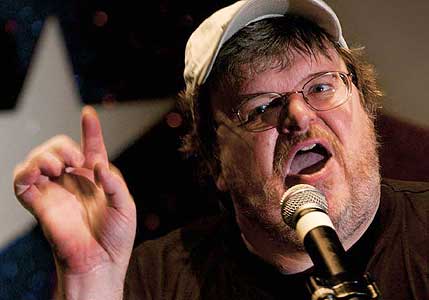
Photos: Our first photo is the fabricator himself. The second photo is an actual queue at an NHS dental service that announced it could take 300 additional patients. Hundreds more turned up than could be accommodated

Labels: , , ,

Saturday, March 10, 2007

Looking inside the Tory party.

I just returned from a dinner with a top Tory party official. The Conservative Party of the UK is out of power and has been for some years. So I was interested in what he was going to say. It is not critical to me who said it so I will leave that part out, but what was said is interesting.

First, he assured everyone that the Conservative Party members of parliament are totally and completely behind David Cameron. I take that to mean that quite a few Conservative Party MPs are not particularly happy with Cameron.

Typically when a top party official speaks to local party members (I was the only outsider present) he is telling them what the party leadership wants people to believe. And what party leaders want the members to believe is happening is often at odds with what is really happening. You can’t exactly say that reality is the complete opposite of the official line but you are safe in saying that the two never quite correspond.

It became apparent to me immediately what issues are dividing the party. It is Cameron’s Labour-lite policies. I say this because the second point this party leader made was that Cameron’s Green politics and such are “really conservative” principles all along. He hammered home that point several times. So it appears that many Tories simply don’t believe it.

The third point he made was that the policies of Cameron are the reason the party is doing well in the polls. His argument is that there is a body of voters who float between the major parties and Cameron’s policies appeal to them. The reason the Conservative Party had lost recent elections, he argued, was that these voters were turned off by Tory policies and now Cameron has struck a cord with them and they are coming home.

This struck me as totally imaginary or very nearly so. If Cameron’s Labour-lite Greenie politics is the key to Conservative Party success that would imply that the reason Margaret Thatcher became one of the longest serving Prime Ministers was due to her Green politics and her mimicking of the Labour Party on policy. The idea strikes me as farcical.

Let us first ask why Tony Blair succeeded. You had John Major distance himself tfrom Thatcher’s policies. He rushed to the Left much the way Bush Sr. did against the Reagan legacy. On the other hand Tony Blair, like Bill Clinton, moved in the opposite direction.

What drives Tory party poll numbers today? The prime reason that people are willing to vote for the Conservatives is disgust over Tony Blair -- disgust that is as justified as disgust over Bush. But our Tory party spokesman tonight kept insisting that the reason for the poll numbers is enthusiastic support for Cameron and I don’t believe it.

Cameron’s electoral strategy is to appear exactly like Labour on most issues. That wins the party some support but dissatisfies their own base. But he hopes to keep the Tory base simply because they are so anxious to send Blair into the electoral dustbin. Even Labour wants that.

Some time soon Blair will be gone. And Gordon Brown will be Labour Party leader. He has nothing great to offer the voters. But he has the same qualification that makes Cameron appealing to so many voters -- he’s not Blair. When Brown takes over the Labour Party, I suspect our speaker of this evening will be in for an unpleasant surprise. He will find that much of what drove Tory poll numbers was disgust for Blair not support for Cameron. I could be wrong, of course, I’ve have been before. We’ll only see when it happens but when Brown takes over I expect a drop in Tory poll numbers and an improvement for Labour.

But Labour has nothing to solve the pressing problems that plague the country. National Health Service is a mess and people are dissatisfied. All Labour can do is promise to spend more money. The “conservative” response is exactly the same thing -- spend more money. Pensions are in crisis and Labour wants to solve the problem by raising the retirement age. The Conservative Party solution is to support Labour.

The Conservative Party is playing down their own policies, they say, because they don’t want Gordon Brown to nick them before the election. But from what I heard this evening Brown would only be nicking back the policies that the Conservatives nicked from Labour. What I’m not seeing is anything that distinguishes the Tories from Labour other than the fact that Cameron isn’t Blair.

Tonight’s speaker did have one point for the true conservatives in the audience. He told them that Cameron is the only Tory leaders in recent years to say he supported marriage! Well, that went over like, like nothing. No reaction. No one seemed to be excited by it. What does it mean in reality -- a few small tax breaks for married people (and I assume those in civil unions). But those few tax breaks will be eaten up by all the other Labour-lite polices the Tories are rushing to adopt. The net result will be higher taxes not lower taxes.

It isn’t that the Tories couldn’t steal thunder from the Left. They could but they won’t. Instead they are mimicking the worst aspects of Labour. I believe Mr. Cameron could support reduced taxes and some other small government proposals and yet steal support from the Left parties if he would publicly state the Conservatives want the immediate withdrawal of British forces from Iraq and Afghanistan.

The Liberal Democrats have done it and saw support grow. At the same time many Lib Dems started sounding more free market and voicing concerns about taxation. No wonder they saw support grow. They were stealing votes from both sides.

Can the Tories win the next election? I suspect they can but not because they are Labour-lite. And the bump they get now, because Cameron is compared to Blair, will die out as well since they won’t be running against Blair. Blair will be on the curb by then. But they will run against a party with no ideas and no means of solving the pressing problems plaguing the country. That will help the Tories to some degree but it appears that they don’t have much to offer either. And it appears their election strategy is to offer nothing.

Like many, come the next election, I’ll be happy about one thing-- Blair won’t be office. I know that whoever is elected president in the United States in 2008 it won’t be George Bush. That thrills me but I have no reason to be excited about any of the likely replacements. And the same is true for Blair. It will be a good thing he is gone and a shame that the main two options will be Brown or Cameron as neither man has what is needed.

Meanwhile I think the Tories should keep an eye on the Liberal Democrats. Just as the Lib Dems have taken support from Labour they are in position to do the same to the Tories. With Cameron sounding very much like a Labour candidate it wouldn’t take much of a shift on the part of the Lib Dems for them to woo over Tory voters. That would create an entire new ball game and a scenario for which the Tories are not prepared.

Labels: , , , ,

Sunday, March 12, 2006

Socialist angry with UK's Liberal Democrats


The antiquated Socialist Party of Great Britain is upset that the Liberal Democrats have a new leader, Menzies Campbell, who is more sympathetic to free markets. Socialists don't like markets. They want to control people when they buy and when they sell and when the exchange with each other. Socialists have contempt for individuals and want to substitute their values for your's.

The Liberal Democrats, they say, have gone to the Right. It's absurd. They hae moved more toward liberty which the Socialists hate. The Lib Dems took a previously safe Labour Party in a recent election. The sad Socialists said this was because"of opportunistically outflanking Labour to the left with pretence at an anti-war stance, opposing attacks on civil liberties etc. On the other hand there has been a decided shift towards economic 'neo-liberalism', in other words right-wing Thatcherism."

Good for the Lib Dems. Labour ceased being a party that supported civil liberties under Blair. The Conservatives ceased being a party of free markets under Major. If the Lib Dems can bring these views back to the forefront they deserve some support.

The Liberal Democrats recently published a book, The Orange Book: Reclaiming Liberalism. The BBC says the book calls for "choice and private sector innovation in public services." The party's Treasury spokesman, David Laws, said the party should reclaim "some of the traditional building blocks of liberalism" and that it should be true "to its Liberal tradition". He notes the party has opposed illiberal assaults on civil liberties but had not stood "against the nanny state". Laws had also said the party made a mistake when it shunned the economic liberalism of Thatcher.

Ros Wynne-Jones, in the Mirror, is particularly unhappy with the Lib Dems as well. He claims: "The Liberal Democrats may seem a viable, anti-war alternative to Labour, but scratch the surface and you'll find a party that supports privatisation, wants to tear down the NHS and whose proposed economic reforms would hurt Britain's very poorest." Anyone naive to think state intervention helps the "very poorest" has a screw loose. But what he does show is that Liberal Democrats are moving in a direction that takes them toward the true meaning of liberalism: pro-peace; pro-social freedom, pro markets. They may not be there yet but these steps are a good sign.

Labels: ,